Debris mass tracked
9,420 t
LEO + MEO survey
The Human Advancement & Evolution Institute is the non-profit research arm of the group — pursuing the fundamental science behind orbital sustainability, multi-domain mobility, propulsion, applied intelligence, and materials, and studying how each advancement reshapes society over the century ahead.
The same real-time engine that powers our commercial platform, turned toward the lab. The observatory streams research telemetry — orbital tracking, propulsion test stands, compute and energy, material trials — so findings can be read as they happen. Below is a working prototype of the research console.
The same frontier programs GalatiCorp commercialises begin here as science — studied for what is true and what is possible before it is built to scale.
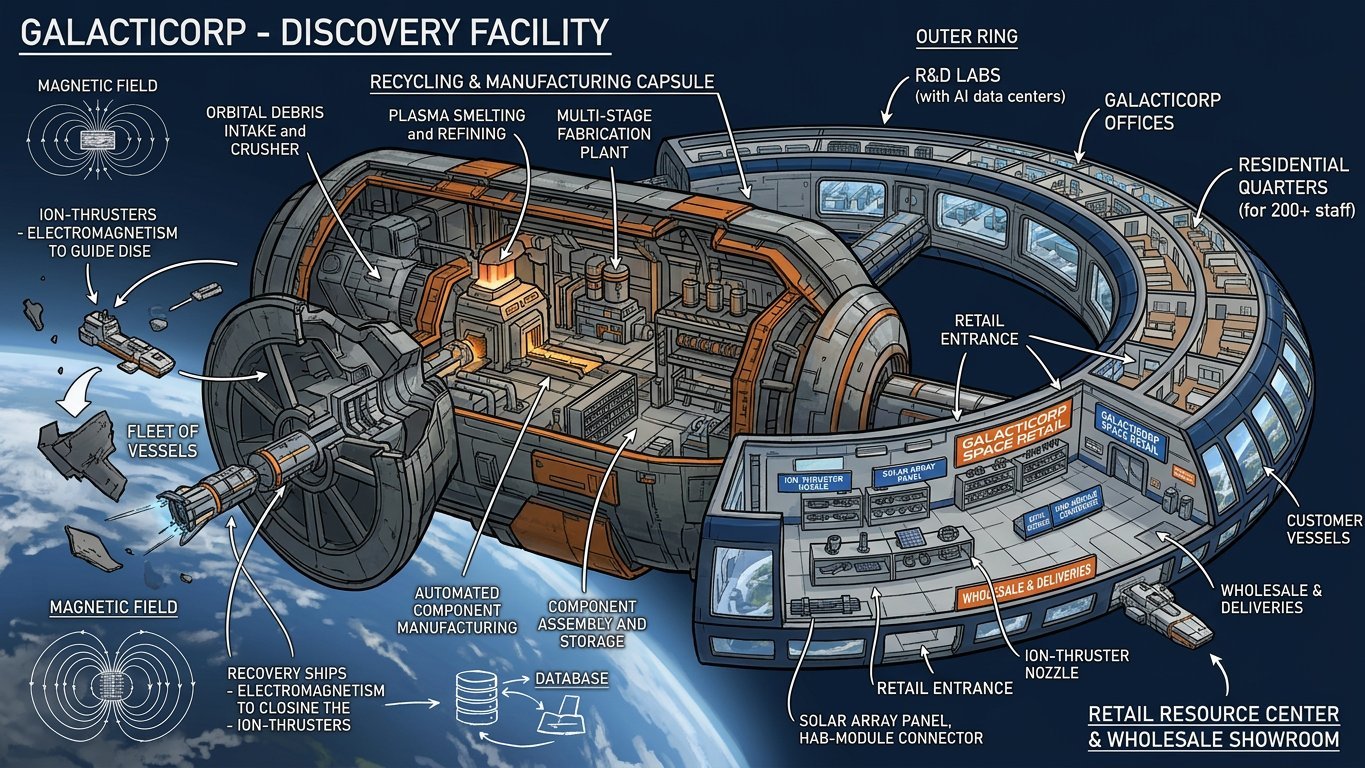
The fundamental study behind the recycling facility: cataloguing debris populations, modelling collision cascades, and testing capture and reprocessing physics — including the electromagnetic versus clean-space approaches — plus the planetary science of asteroid and crystalline-body resources. The aim is a rigorous basis for an orbital environment that stays open to everyone.
The Universal Dynamic Vessel studied as a physics problem: how one airframe holds up across aerodynamic, hydrodynamic, and vacuum regimes. Research spans high-pressure hull mechanics, ablative thermal protection for re-entry, hydrogen and ion/magnetohydrodynamic propulsion, and the control science of transitioning between air, water, and orbit without compromise.
The same foundation GalatiCorp reads as markets, HAE reads as fields of study — pursued for understanding first, application second.
The physics and chemistry of reprocessing recovered mass into usable feedstock and producing in microgravity.
Capture dynamics, repair manipulation, and the evaluation-station logic for classifying recovered material.
Characterising crystalline bodies and extraterrestrial materials for extraction and study.
Comparative study of ion, electromagnetic, and magnetohydrodynamic drives — clean-space versus electromagnetic approaches.
Proprietary AI models, dedicated AI-chip architecture, and the energy and electromagnetism research that sustains them.
Polyfibre composites, robotic actuators, and high-tolerance materials for pressure, thermal, and vacuum extremes.
As a non-profit institute, HAE studies not just whether something can be built, but what it does to the people who live with it. Every program carries a parallel inquiry into the societal effect of the technology — so the century we are helping to author is one worth living in.